UTMB Strategy
UTMB Aid-Station Gaps: How to Fuel Before the No-Margin Sections
A practical fueling playbook for UTMB's long no-aid gaps: buffer rules, timing, and how to avoid the late-race spiral.

The real problem: you start the UTMB no-aid section under-fueled
Most runners don't fail UTMB on fitness. They fail on execution.
- Eat before you leave any major aid station.
- Carry a buffer: +1 gel +250–500 ml.
- Set a timer: carbs every 20–30 min.
- First half of the gap = no surges.
The biggest silent killer isn't a steep climb. It's leaving an aid station with a half-empty tank, telling yourself you'll eat soon, and then realizing an hour later that you can't stomach anything, your pace is collapsing, and you're negotiating with yourself just to keep moving.
If you've ever bonked, you already know the feeling: your brain goes gray, your legs feel hollow, and every decision becomes hard.
Here's the practical playbook: treat long no-aid gaps as no-margin segments. You don't wing it. You pre-fuel, carry a buffer, and follow a timer schedule.
Want to see the biggest gaps highlighted on the course? Try the free UTMB open course poster here: /utmb-pacing-strategy
(Unofficial open course. Not affiliated with UTMB.)
A simple buffer rule (no math, no heroics)
When you leave an aid station for a long gap, do three things:
- Eat before you leave (don't start the gap empty)
This is the #1 mistake. People refill bottles and forget to refill themselves.
Rule: Eat something at the station, then leave.
Even if it's small: 1 gel, a few bites of banana, half a bar, or a cup of sports drink.
- Carry a buffer (because plans fail)
Your buffer is your insurance policy.
Rule-of-thumb buffer: +1 gel more than you think you need, +250–500 ml more fluids than you planned.
Sodium early, not after cramps.
This is not overpacking. This is preventing the spiral: low fuel → low output → more time in the gap → even lower fuel.
- Use a timer schedule (willpower doesn't work at hour 12)
When fatigue hits, you won't remember to eat.
Rule: Put intake on autopilot.
Carbs: every 20–30 min. Fluids: steady sipping (don't chug). Sodium: small, consistent doses if heat/sweat is high.
Hotspots from the open course (what no-margin really looks like)
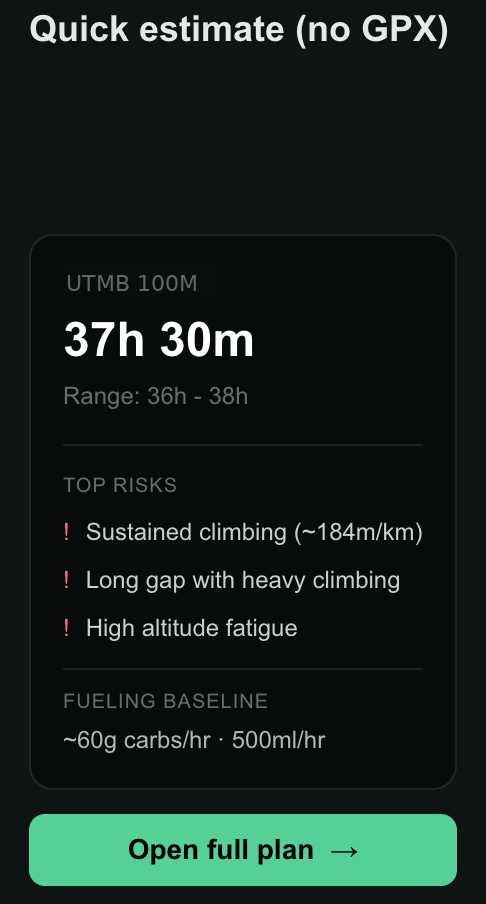
On our Alpine 100M-style open course, the top execution risks are not vague hard sections — they're measurable hotspots that compound fatigue fast:
- Sustained Climbing Load (High) — ~184 m/km
Why it matters: Dense climbing in a short span drains glycogen fast and spikes fatigue way faster than distance-only pacing predicts.
How we flag it: a 1 km sliding window. ≥100 m/km = trigger, ≥150 m/km = High.
What to do: treat this as a no-surge zone. Hike earlier than you want, keep cadence steady, and start fueling on the climb (don't wait for the top). If you feel great here, that's exactly when you're most likely to overpay later.
- No-aid gap — 149 min + heavy climbing
This is a true no-margin segment: if you leave under-fueled, you don't fix it later.
Before you leave: eat something at the station, then carry a buffer: +1 gel and +250–500 ml more fluid than your plan.
During the gap: run a 20–30 min timer for carbs. Keep the first half controlled—no surges while you still feel fresh.
- No-aid gap — 132 min + heavy climbing
Small mistakes compound here. Start sipping in the first 20–30 minutes, keep climbs controlled, and protect your gut.
If intake starts to stall: switch form (gel → drink calories / sweet → salty), go smaller bites, and drop effort for 5–10 minutes to let your stomach reset. Fix fueling first, then pace.
Get the UTMB gap map (free)
See the longest no-aid sections highlighted on the elevation profile + checkpoint ETAs.
(Unofficial open course. Not affiliated with UTMB.)
/utmb-pacing-strategy
UTMB aid station strategy: before, during, after the gap
UTMB fueling checklist: before leaving the aid station
Your only goal is to leave with confidence.
- Eat something now.
- Top up bottles/bladder for the actual gap length.
- Pack a buffer (gel + fluid).
- Set your timer (20–30 min cadence).
- Decide one sentence for pacing: "I will not chase minutes in the first half of this gap."

First 20 minutes of the gap (the free speed window)
- Start controlled.
- Get your first intake early (don't delay).
- Keep effort sustainable on climbs (hike sooner than you want).
If you start the gap by spending matches, you'll pay interest later.
How to fuel between aid stations UTMB: mid-gap
This is where reality kicks in: climbing load, technical footing, temperature changes, and the mind starts bargaining.
Your job is boring:
- Keep eating on schedule.
- Keep sipping.
- Keep effort controlled on climbs.
- Make the downs smooth (don't brake hard).
If intake stalls (common late-race issue)
When you can't eat, do this in order:
- Switch form: gel → drink calories, or sweet → salty.
- Go smaller: tiny bites more often.
- Warm fluids if possible (helps a lot at night/cold).
- Reduce intensity for 5–10 minutes to reset the gut.
Key idea: Fix fueling first, then pace.
Common mistakes (that look small but cost hours)
Mistake 1: I'll eat after the climb
That's how you accidentally skip 60–90 minutes of intake. Fix: Eat before the climb. Then maintain small, steady intake.
Mistake 2: Leaving the station in a hurry, then organizing on trail
You burn minutes and forget to eat. Fix: Organize at the station. Leave ready.
Mistake 3: Carrying fluid but not electrolytes (or vice versa)
Hydration is not just water. In long races, you need both. Fix: If sweat is high, bring a simple sodium plan (small doses early).
Mistake 4: Treating long gaps like normal trail running
In training, you can bonk and limp home. In UTMB, you pay with hours. Fix: Long gap = execute the checklist.
Try it on the course (free UTMB open course poster)
If you want to see the biggest no-aid gaps, where they coincide with heavy climbing, and how a conservative vs steady strategy changes timing, use the UTMB open course page: /utmb-pacing-strategy
Then, when you're ready: Upload your GPX for your own race plan.
Final note: This is an execution aid, not a guarantee. Weather, trail conditions, and your choices still matter.